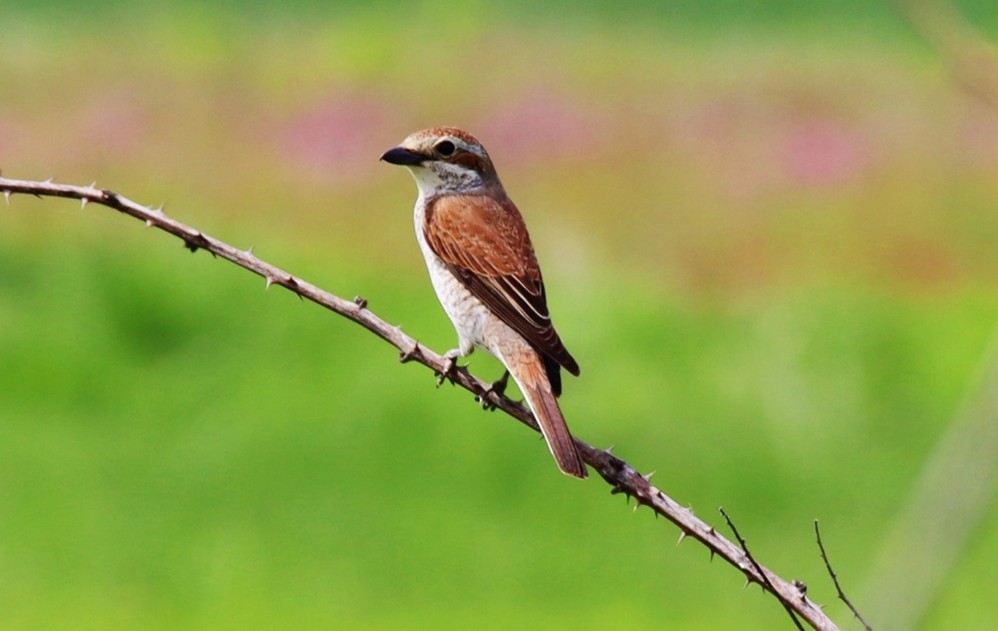
What do biodiversity policies and the small bird in the picture, the red-backed shrike, have in common? Both reconnect landscapes, people, and the broader systems in which they are embedded. While this migratory bird links Africa and Europe through the African–Eurasian Flyway, biodiversity policies must connect ecological objectives with the diverse ways people value and experience nature.
Through studies conducted in four cities across two continents, the RECONNECT project explored how reconnecting people with nature can support more inclusive biodiversity governance. Building on this work, the research examines how the diverse values of nature introduced in the Kunming–Montreal Global Biodiversity Framework (GBF) can be integrated into the EU Nature Restoration Regulation (NRR) and its National Restoration Plans (NRPs).
The findings show that successful restoration policies depend not only on ecological targets, but also on collaboration across sectors and communities. Articles 11 and 14 of the NRR focus on restoring agricultural landscapes and addressing fragmentation through cooperation, while Article 8 promotes urban green spaces and tree canopy cover. The Reconnect policy brief presents how local efforts could be strengthened through municipal-level groups and participatory tools such as geo-design, spatial mapping, and polycentric governance approaches.
The red-backed shrike serves as a fitting symbol for this approach. The species thrives in restored, multifunctional agricultural landscapes shaped through cooperation between conservation, farming, and local communities. As such, it reflects the broader challenge of reconnecting biodiversity conservation with the landscapes and societies in which it is embedded.
The researchers propose three main recommendations:
- Embed diverse value systems into National Restoration Plans.
- Strengthen communication on restoration through shared symbols.
- Support collaborative governance approaches in urban and peri-urban landscapes.
The Reconnect policy brief showcases how concrete approaches can support effective and inclusive local actions that contribute to achieving regional and global biodiversity targets and objectives for the greater good of all. The publication can be found here.